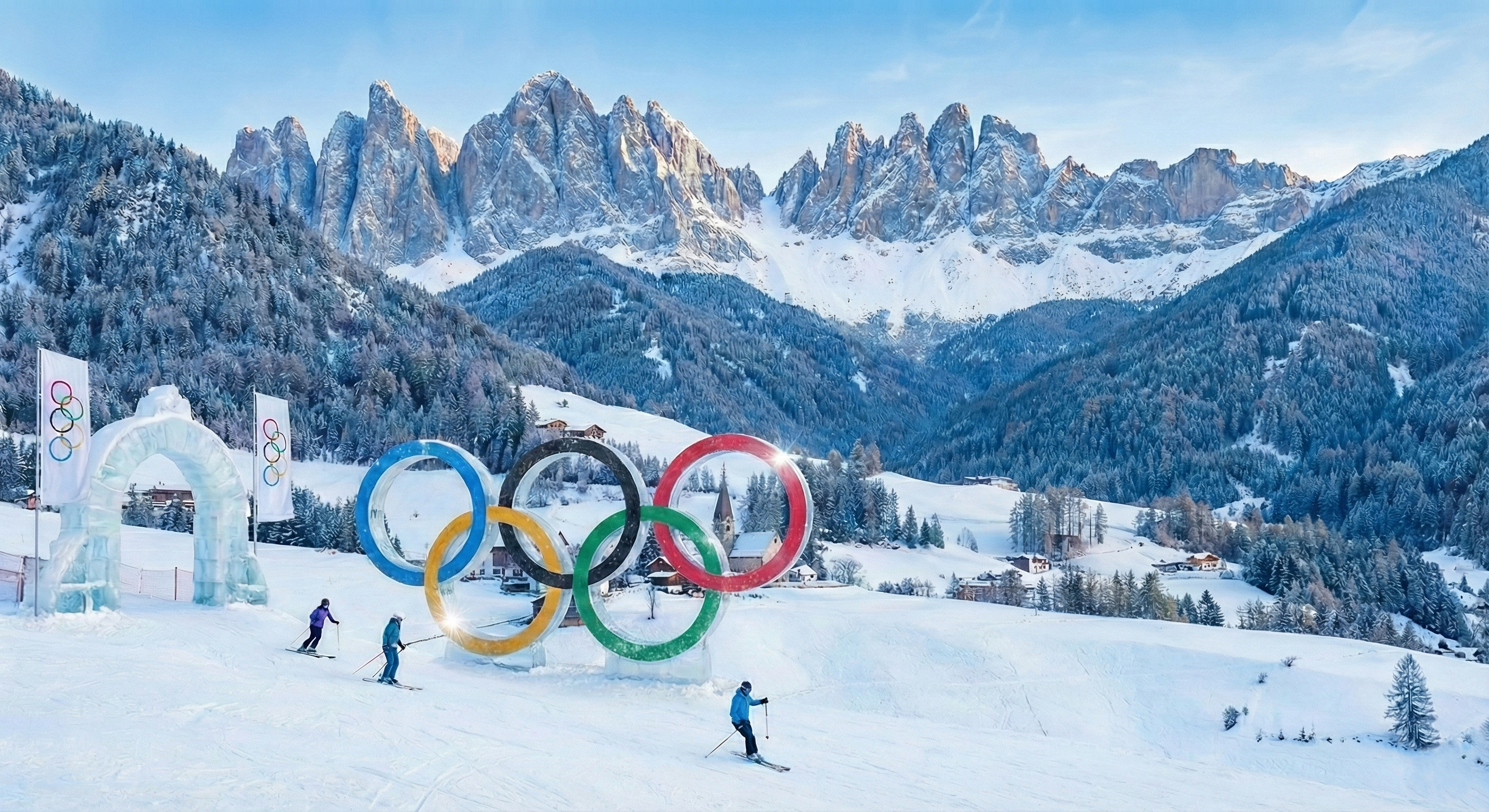
The countdown is finally over. Tomorrow, Friday, February 6, 2026, the Olympic flame will once again illuminate the Italian sky.
As the sun sets over the Lombardy plains and the jagged peaks of the Dolomites, the Milano Cortina 2026 Winter Olympics will officially begin. This is not just a sporting event; it is a historic “widespread” celebration that promises to redefine the Olympic experience by bridging the urban sophistication of Milan with the raw, Alpine beauty of Cortina d’Ampezzo.
Here is your complete guide to the Opening Ceremony, the tourism explosion rocking Northern Italy, and the history-making sports debuting this weekend.
1. The Opening Ceremony: A Tale of Two Cities
For the first time in the history of the Games, the Opening Ceremony will not be confined to a single stadium. In a bold move symbolising “unity,” the event will unfold simultaneously across two distinct worlds starting at 20:00 CET.
- The Urban Stage (Milan): The legendary San Siro Stadium will host the main spectacle. Over 80,000 spectators will witness the Parade of Nations, where athletes will march into a stadium transformed into a futuristic theatre of light and sound.
- The Alpine Stage (Cortina): Simultaneously, the Piazza Dibona in Cortina d’Ampezzo will host a mirror celebration, focusing on the intimate traditions of the mountains.
- The “Twin Flame”: In a poetic twist, two Olympic cauldrons are expected to be lit at the exact same moment—one at Milan’s Arco della Pace and the other in the Dolomites—connected by live satellite feeds.
- Star Power: The lineup reflects Italy’s cultural dominance. Expect emotional performances from Andrea Bocelli and Laura Pausini, alongside rumoured international headliners like Mariah Carey, bringing a touch of global pop to the Italian night.
2. The “Olympic Effect”: Tourism & Economy
The return of the Olympics has triggered a massive economic windfall for Italy, often referred to as the “Olympic Effect.” The numbers emerging on the eve of the Games are staggering.
The Tourism Surge
- Visitor Numbers: Italy expects over 1.5 million visitors specifically for the Games, with millions more extending their stays to visit Venice and Verona.
- Sky-High Demand: Hospitality rates have surged to record levels. In Milan, hotel prices for the opening weekend are up 119% compared to last year. In the mountain hubs like Cortina and Bormio, finding a room under €800 per night is now virtually impossible.
- The Luxury Boom: 2026 is the “Luxury Olympics.” High-net-worth individuals have descended on Milan’s Fashion District, where 5-star suites are fetching upwards of €2,600 per night.
- Infrastructure Legacy: Unlike past games that built “White Elephants” (useless stadiums), Italy has invested €1.2 billion into upgrading rail and road networks, ensuring that tourists will benefit from faster travel times for decades to come.
3. History on Snow: New Sports & Venues
Milano Cortina 2026 is unique because it uses 93% existing or temporary venues, making it one of the most sustainable Olympics ever. But while the venues are historic, the sports are evolving.
- New Sport Alert: Ski Mountaineering (SkiMo):
– Making its Olympic debut in Bormio, this is a gruelling test of endurance. Athletes must race uphill using “skins” on their skis, hike on foot across rugged terrain, and then race downhill through gates. It’s fast, frantic, and perfect for TV. - The “Blue Ribbon” Event:
– Do not miss the Men’s Downhill this Saturday, Feb 7. Held on the legendary Stelvio Piste in Bormio—one of the most difficult and dangerous courses in the world—it is widely considered the crown jewel of the Winter Games.
4. Viewing Guide: How to Watch Tomorrow
If you aren’t among the lucky fans in San Siro, here is where you can catch the Opening Ceremony live:
- 🇺🇸 USA: NBC & Peacock (Live coverage starts at 2:00 PM ET).
- 🇪🇺 Europe: Eurosport & Discovery+ (Pan-European coverage).
- 🇬🇧 UK: BBC One & iPlayer.
- 🇨🇦 Canada: CBC & CBC Gem.
5. Olympics & Tourism: 5 Fascinating Facts
The relationship between the Games and travel is complex. While we expect a boom, history shows the “Olympic Effect” is full of surprises.
1. The “Displacement Effect” (The London Warning)
You might assume host cities are overflowing, but the Olympics often scare away regular tourists. During the London 2012 Games, visits to famous attractions like the British Museum actually dropped because non-sports tourists avoided the city, fearing crowds and high prices. Italy is combating this by spreading events across three regions (Lombardy, Veneto, Trentino), hoping to diffuse the crowds rather than concentrate them.
2. The “Barcelona Model”
Every host city dreams of being Barcelona. Before the 1992 Summer Olympics, Barcelona was an industrial port city often ignored by tourists. The Games were used as a catalyst to build an artificial beach and renovate the waterfront. The result? Barcelona became one of the top tourist destinations in Europe permanently. Milan hopes 2026 will do the same for its status not just as a business hub, but as a leisure destination.
3. The Oldest Tourism Event in History
Sports tourism isn’t new; it’s ancient. The original Olympics (starting 776 BC) were the ancient world’s biggest tourism driver. Greeks from all over the Mediterranean would travel for weeks to reach Olympia. The demand was so high that a “Sacred Truce” (Ekecheiria) was declared, granting safe passage to travellers passing through warring territories—essentially the world’s first diplomatic visa.
4. The “Halo Effect” (Screen Tourism)
The biggest tourism payoff doesn’t happen during the Games; it happens after. With an estimated 3 billion global viewers tuning in, the Olympics serve as a 16-day commercial for Italian scenery. Studies show that iconic imagery (like the ski jumpers soaring over the Dolomites) creates a “bucket list” desire that boosts tourism for 4–5 years after the flame goes out.
5. The “White Elephant” Extinction
Tourism turns sour when “White Elephants”—expensive, abandoned stadiums—are left behind (as seen in Athens and Rio). Milano Cortina 2026 is pioneering “Sustainable Tourism.” By refusing to build new massive structures, they are attracting a new wave of eco-conscious travellers who support the idea of reusing heritage sites rather than pouring new concrete.
The world is ready. Italy is ready. Let the Games begin.