Sleep tourism is travel planned around one goal: sleeping better. Instead of filling every day with sights, sleep tourists choose hotels, retreats and destinations for quiet, darkness, a great bed and a daily rhythm that resets the body clock. The range is huge: a sleep-designed boutique room in Portugal at normal hotel rates, a Six Senses sleep programme in Rome from €810, or a week in a Swiss sleep clinic at CHF 7,960 before the room. Research firms put the global market at roughly $73–82 billion today and expect it to reach $119–238 billion by the early 2030s.
This guide explains what sleep tourism is, what the science says actually works, the best sleep hotels and retreats in Europe and further away with their published prices, which destinations suit which kind of traveller, and how to plan a sleep trip on any budget. Several of the best options are a cheap short-haul flight from the Baltics, Scandinavia, Poland or Germany.
- What it is: a trip where better sleep is the main purpose, not a side effect. Also called a “sleepcation”.
- Why it is booming: ResMed’s 2025 survey of 30,026 people in 13 countries found people lose almost three nights of restorative sleep every week. Hilton’s 2024 Trends Report found “rest and recharge” was the top reason to travel.
- Four levels: a sleep-smart hotel night, a sleep-designed hotel, a resort sleep programme and a medical sleep clinic.
- Prices: from normal room rates up to several thousand euros a week for medical programmes, with rooms charged extra.
- Stay at least 3 nights: your brain sleeps lighter on the first night in any new place.
- Stay close to home: 0–2 time zones away means no jet lag. In Europe that includes Druskininkai (Lithuania), Coimbra and the Douro (Portugal), the Swiss lakes and Spain’s Costa Blanca.
- Not a cure: long-term insomnia and sleep apnoea need a doctor. The recommended first treatment for chronic insomnia is CBT-I, a short course of cognitive behavioural therapy, not a holiday.
What is sleep tourism?
Sleep tourism means choosing a destination, a hotel or a programme mainly because it will help you sleep. A spa weekend makes you feel relaxed. A sleep trip is judged by one thing: did you fall asleep faster, wake up less and feel rested?
Good sleep trips work on four things at once:
- The room: dark, quiet, cool and well ventilated, with a bed and pillow that suit you.
- The rhythm: morning daylight, movement during the day, meals at regular times and calm evenings, so the body clock gets clear signals.
- The know-how: sleep coaches, doctors or simple routines that you can take home.
- The place: forests, lakes, the sea or mountains, away from nightlife, traffic and light pollution.
The idea is old. Europe’s spa towns were selling rest long before anyone said “wellness”. Druskininkai in southern Lithuania received health-resort status by a decree of King Stanisław August Poniatowski on 20 June 1794. What is new is the scale and the technology: smart mattresses that track your sleep, rooms that dim and cool themselves before bedtime, and big hotel chains with their own sleep programmes.

Level 1: a sleep-smart hotel night
This is any trip where you pick and use the room for sleep: a quiet room on a high floor, blackout curtains, a cool temperature and no late screens. Some chains build it into the brand. Premier Inn in the UK runs a Good Night Guarantee: if you do not sleep well and the hotel cannot fix the problem, you can claim a refund for that night, as long as you tell reception during your stay. London’s Zedwell hotels have windowless, soundproofed rooms with filtered air and no TV.
Level 2: a sleep-designed hotel
These hotels were built around sleep, but you pay ordinary hotel rates and plan your own days. Two of the best in Europe are the Hästens Sleep Spa in Coimbra, Portugal, where every room has a handmade Hästens bed, and MANA Sleep & SPA in Druskininkai, Lithuania, which was designed for guests with sleep problems and chronic fatigue.
Level 3: a resort sleep programme
Here you book a package: sleep tracking, consultations, massages, yoga or breathwork and sleep-friendly meals, usually over 3–7 nights. Six Senses runs sleep programmes at many resorts, from Rome and Ibiza to the Douro Valley and Kyoto. Expect to pay hundreds of euros per day.
Level 4: a medical sleep clinic
Medical spas such as SHA in Spain, Lanserhof in Germany and Chenot and the Grand Resort Bad Ragaz in Switzerland add doctors, blood tests and sometimes a full overnight sleep study. A week costs several thousand euros before the room. This is the only level that can find a medical cause for poor sleep, such as sleep apnoea.
Why sleep tourism is booming in 2026
The simplest answer is that many people sleep badly, and they have started spending money on it.
- Bad sleep is normal now. ResMed’s 2025 Global Sleep Survey of 30,026 people in 13 countries, including Germany, France and the UK, found that people lose almost three nights of restorative sleep a week. In the US, the National Sleep Foundation’s 2025 Sleep in America Poll found that six in ten adults are not getting enough sleep.
- Travellers say rest is the point. In Hilton’s 2024 Trends Report, a survey of more than 10,000 travellers in nine countries, “rest and recharge” was the top reason to travel in every generation. Nearly one in ten said they travel with a white-noise machine.
- Quiet is a trend. Hilton’s 2026 report (Ipsos survey of 14,009 adults in 14 countries) calls it “Hushpitality”. Among business travellers, 19% choose sleep over socialising with colleagues.
- The money is big. The Global Wellness Institute’s 2026 sleep trends report puts the wider “sleep economy”, from mattresses to apps, at over $585 billion.
How big is sleep tourism itself? It depends on who you ask. All three major forecasts start in the same place, about $73–82 billion in 2024–2025, but they diverge sharply because each firm defines “sleep tourism” differently. Some count only trips booked for sleep. Others count a share of all luxury and wellness hotel spending.
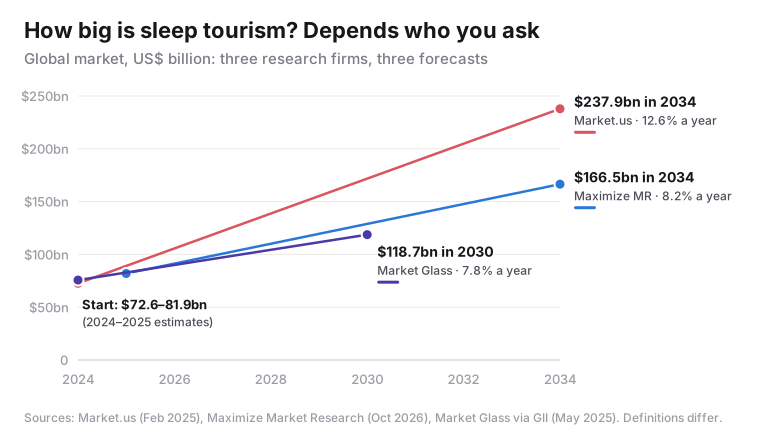
Market.us and Maximize Market Research both put North America’s share at about 35%. Market Glass expects luxury hotels to grow faster than the market as a whole, at 9% a year, to $57.7 billion by 2030.
Does it work? What sleep science says about sleeping away from home
A trip can genuinely improve your sleep, but not for the reasons the brochures usually give. Thread counts and lavender sprays are nice. The evidence is strongest for five much simpler things.
1. The first-night effect: why you sleep badly in a new hotel
In a 2016 study in Current Biology, researchers at Brown University found that on the first night in an unfamiliar place, one side of the brain stays partly on guard. A network in the left hemisphere slept less deeply and reacted faster to unusual sounds. By the second night, both sides slept equally deeply. The researchers compare it to a night watch. In practice: one-night sleep breaks are a poor deal. Book at least three nights and do not judge the trip by night one.
2. Light is the strongest lever
Your body clock is set mainly by light. Ordinary room light (under 200 lux) in the evening delayed the release of the sleep hormone melatonin in 99% of participants and shortened it by about 90 minutes, according to a 2011 study in the Journal of Clinical Endocrinology & Metabolism. In the opposite direction, University of Colorado researchers sent volunteers camping with no artificial light. After a summer week, their melatonin rose almost two hours earlier. A later study found that one weekend of camping already produced a 1.4-hour shift, 69% of the full week’s effect.
This is why so many sleep retreats sit in forests, by lakes or in the mountains, and why the best ones push you outside in the morning and dim the lights after dinner.
3. Cool, dark, quiet rooms
The Sleep Foundation suggests a bedroom of about 18°C (65°F), and most doctors recommend 18–20°C. Many hotels default to warmer temperatures. Quiet and darkness matter for the same reason: light and noise interrupt sleep even when you do not fully wake up. The quickest test of a “sleep hotel” is whether you can control all three in your room.
4. Altitude: mountain air is not always restful
Above about 2,500 metres, many people develop periodic breathing at night, a cycle of fast breathing and short pauses that fragments sleep. Medical reviews report it in about a quarter of people who climb quickly above 2,500 m and in almost everyone above 4,000 m. Europe’s sleep clinics are mostly at low altitude: Bad Ragaz sits at about 500 m and Weggis on Lake Lucerne at about 440 m. For a sleep holiday, a lake or a valley usually beats a high ski resort.
5. The fade-out problem
Holiday benefits disappear fast. In a 2010 study of 96 Dutch workers, health and well-being improved during a winter holiday but were back to pre-holiday levels in the first week back at work. A sleep trip that only feels good while you are away is a spa holiday. The programmes worth paying for teach you habits you can keep at home.

The best sleep hotels and retreats in 2026, with prices
We checked each place against the operator’s own page or recent independent coverage in October 2026. Prices are published “from” rates at the date shown in brackets and change often. “pp” means per person.
| Hotel or retreat | Where | What makes it a sleep stay | Published price |
|---|---|---|---|
| MANA Sleep & SPA | Druskininkai, Lithuania | Designed for sleep problems and fatigue; smart beds, circadian lighting, medical spa | Hotel rates |
| Hästens Sleep Spa | Coimbra, Portugal | 15 rooms, Hästens Herlewing beds, five-pillow menu, adults only | Hotel rates |
| Zedwell | London, UK | Windowless, soundproofed rooms, filtered air, no TV | Hotel rates |
| Six Senses Rome | Rome, Italy | Sleep tracking with daily reviews, massages, Roman bath sessions | From €810 pp, programme (2026) |
| Six Senses Douro Valley | Douro Valley, Portugal | 3–7-night sleep retreat with screening and spa treatments | From £2,069 pp sharing, 3 nights incl. room (low season 2024) |
| SHA Wellness Clinic | L’Albir, Alicante, Spain | Medical Sleep Recovery programme | From €4,000 for 7 days, suites from €330 a night |
| Lanserhof Sylt | Sylt, Germany | Medical Sleep Well programme, Neuro Sleep Reset biofeedback module | $6,040 pp for 7–8 nights, room extra (2025) |
| Chenot Palace Weggis | Lake Lucerne, Switzerland | Sleep Cycles: treatments timed to your chronotype, no trackers | CHF 7,960 for 7 nights, rooms from CHF 530 a night (2026) |
| Grand Resort Bad Ragaz | Bad Ragaz, Switzerland | Sleep diagnostics with an overnight sleep study read by a sleep doctor | On request |
| Six Senses Kyoto | Kyoto, Japan | “Sleepcation” package, valid until 31 December 2026 | On request |
| Hoshinoya Karuizawa | Nagano, Japan | Seasonal Sleep Stay: forest bathing, hot springs, pillow fitting | ¥56,900 pp + room (summer 2026) |
| Kamalaya | Koh Samui, Thailand | Sleep Enhancement programme with acupuncture and naturopathy | Programme + room |
| Equinox Hotel New York | New York, USA | “The Sleep Lab” rooms designed with sleep scientist Matthew Walker | Room rates |
| Park Hyatt New York | New York, USA | Bryte Restorative Sleep Suite with a self-adjusting smart bed | From $1,445 a night (at launch, 2022) |
| Post Ranch Inn | Big Sur, California, USA | 2-night Sleep Program; rooms without TV or alarm clock | $4,250 for one, $4,850 for two (2025) |
| Longueville Manor | Jersey, Channel Islands | 2-night sleep stay with a psychotherapist, spa treatments | From about $697 a night for two (2025) |
| Kakslauttanen Arctic Resort | Saariselkä, Finnish Lapland | Glass igloos for watching the northern lights from bed | Hotel rates |
Price sources: Six Senses Rome and Chenot from the operators’ websites; Six Senses Douro Valley from UK agent Healing Holidays; SHA from Stylist magazine; Lanserhof Sylt, Post Ranch Inn and Longueville Manor from AARP (May 2025); Park Hyatt New York from its 2022 launch announcement; Hoshinoya Karuizawa from Premium Japan (June 2026).
Medical sleep clinics in Europe
SHA Wellness Clinic (Spain). SHA sits on a hillside in L’Albir on the Costa Blanca, about an hour’s drive from Alicante airport, which has cheap flights from most of Europe (from Riga, for example). Its Sleep Recovery programme adds medical consultations and therapies to a stay. Stylist reported rates from €4,000 for seven days, with suites from €330 a night. Spain is in the same time zone as Germany, Poland and Scandinavia, so there is no jet lag.
Lanserhof Sylt (Germany). On the North Sea island of Sylt, Lanserhof’s Sleep Well programme starts with a phone consultation and a medical analysis of your sleep, then builds a personal plan. AARP put the medical programme at $6,040 per person for seven to eight nights in 2025, without the room. The newer Neuro Sleep Reset is a three-day intensive within a seven-night stay, with 12 biofeedback sessions that train the brain’s relaxation rhythms while it is monitored in real time.
Chenot Palace Weggis (Switzerland). Chenot’s Sleep Cycles programme on Lake Lucerne is the opposite of “sleepmaxxing”: no trackers on your wrist. Treatments are timed to your chronotype, whether you are naturally a morning or an evening person. A minimum seven-night stay includes three medical consultations, two nutrition consultations, the plant-based Chenot Diet, six sessions each of heart-rate-variability biofeedback, neuro-acoustic relaxation and whole-body cryotherapy, plus temperature-balancing sleepwear. The programme costs CHF 7,960. Rooms start at CHF 530 a night.
Grand Resort Bad Ragaz (Switzerland). This is the choice for a diagnosis rather than a treat. The resort’s medical centre runs a sleep diagnostics programme built around overnight video polysomnography, the same sleep study a hospital sleep lab would do, read by a sleep physician. It also includes blood tests, a lung function test and a doctor’s consultation. Bad Ragaz is just over an hour by train from Zurich.
Luxury sleep programmes
Six Senses (Italy, Portugal, Spain, Japan and more). Six Senses offers sleep programmes at many of its resorts. In Rome, the sleep programme starts at €810 per person and includes two sleep-tracking sessions with daily reviews of the results, two 60-minute massages, a wellness screening, two fitness or wellness sessions, three visits to the Roman bath and a bag of sleep amenities. A longer version costs €1,450. In the Douro Valley, a three-night sleep retreat started at £2,069 per person sharing in low season 2024, including the room. At Six Senses Kyoto, the “Sleepcation” package of a personalised sleep programme, treatments and nutrient-rich meals is valid until 31 December 2026. Six Senses also runs sleep programmes at Ibiza, Kaplankaya in Türkiye, Koh Samui and Zil Pasyon in the Seychelles, where it costs €2,070 per person without the room.
Hoshinoya Karuizawa (Japan). Karuizawa is a cool forest resort town about an hour from Tokyo by bullet train. Each summer, Hoshinoya runs a three-day “Karuizawa Sleep Stay” built around the body clock. It combines forest walks, hot-spring bathing with a breathing technique, a pillow adjusted by staff, an “Awakening Breakfast” and a cooling evening meal. The 2026 edition ran from 1 July to 31 August and cost ¥56,900 per person on top of the room. Watch for the 2027 dates.
Equinox Hotel New York (USA). In July 2025, Equinox launched The Sleep Lab with Matthew Walker, the neuroscientist behind the bestseller Why We Sleep. Four river-view rooms have Eight Sleep mattresses whose temperature each partner can set separately, biometric sleep tracking and a room that adjusts temperature, light and sound starting about 30 minutes before your chosen bedtime.
Park Hyatt New York (USA). The Bryte Restorative Sleep Suite has a smart bed that senses your movement and adjusts its support through the night. At its launch in 2022, rates started at $1,445 a night.
Grand Wailea, Maui (USA). In March 2024, Hilton launched its first Sleep Retreats at this Waldorf Astoria resort, designed with Dr Rebecca Robbins of Brigham and Women’s Hospital in Boston. They include spa treatments against jet lag, talks on how sleep works, sleep-promoting meals and a personal sleep schedule.
Kamalaya (Thailand). The Koh Samui wellness resort’s Sleep Enhancement programme draws on traditional Chinese medicine and naturopathy, with treatments such as acupuncture, Shirodhara oil therapy and foot massage. Programmes are priced separately from the room. Flights from Europe usually connect in Bangkok (see this Riga to Koh Samui deal).
Sleep-designed hotels at normal prices
Hästens Sleep Spa, Coimbra (Portugal). The Swedish bed maker Hästens, which has made beds by hand in Köping since 1852, opened this 15-room hotel in 2021. Every room has a limited-edition Hästens Herlewing bed. There is a menu of five pillows of different sizes, materials and firmness, a TV channel with sleep-health videos and staff trained in sleep practices. The decor is inspired by Coimbra University’s baroque Biblioteca Joanina library. The hotel is adults only and now trades as Hästens Sleep Experience by FLH Hotels. Check prices on Booking.com.
MANA Sleep & SPA, Druskininkai (Lithuania). MANA opened as Amberton Green SPA Druskininkai and was designed, in its developer’s words, for people suffering from sleep disorders and chronic fatigue. Rooms have smart beds that assess sleep quality, circadian lighting and sound systems for therapeutic music, and booking sites list Tempur mattresses. A medical and wellness centre with 20 treatment rooms, an indoor pool and saunas complete the picture. Check prices on Booking.com.
Zedwell (London, UK). A different approach: rooms with no windows at all, soundproofed walls, filtered air and no TV, in the middle of the city. Zedwell runs several London hotels, including at Piccadilly Circus and Greenwich. They are ideal for a city break where you still want to sleep properly.
Westin (worldwide). Westin’s Sleep Well range, the Heavenly Bed, a lavender balm and a Sleep Well room-service menu, is the most accessible sleep-branded chain option. It is a good standard, not a retreat.
The best sleep tourism destinations by country
Where you go matters as much as the hotel. Light, climate and the time difference from home all affect how well a trip resets your sleep.
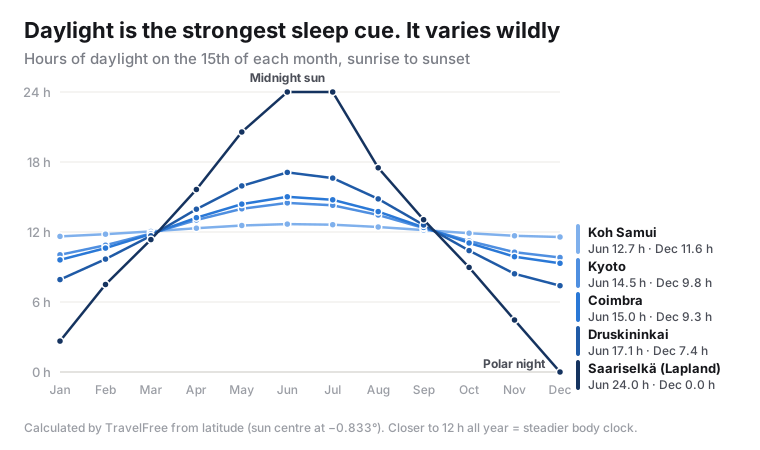
The further north you go, the bigger the swing in daylight. That does not make the north bad for sleep, but you have to plan for it. In summer, the long evenings in the Baltics and Scandinavia make blackout curtains essential. In winter, the long dark evenings help, but you need to get outside in the middle of the day for bright light. Destinations closer to the equator keep the body clock steadier all year.
Lithuania: Druskininkai, the Baltic sleep spa

Druskininkai is Lithuania’s oldest spa town, with resort status since 1794. It sits on the Nemunas river in the far south of the country, surrounded by pine forest, and has mineral springs, mud treatments and many spa hotels. The town’s tourist office says it is home to “the only sleep spa in Northern Europe”, and the sleep-focused MANA Sleep & SPA is the clearest example. It is about 1 h 45 min by car from both Vilnius and Kaunas airports, and both have cheap direct flights across Europe. For a low-cost sleep weekend, Druskininkai is hard to beat: same time zone as Finland, short flights, and spa hotel prices well below Western Europe’s, especially on weekdays outside summer.
Elsewhere in the Baltics, the seaside resorts of Jūrmala (Latvia) and Pärnu (Estonia) and the Lithuanian spa town of Birštonas offer the same basic recipe of pine forests, spa hotels and quiet nights out of season. They do not have dedicated sleep programmes.
Portugal: Coimbra and the Douro Valley
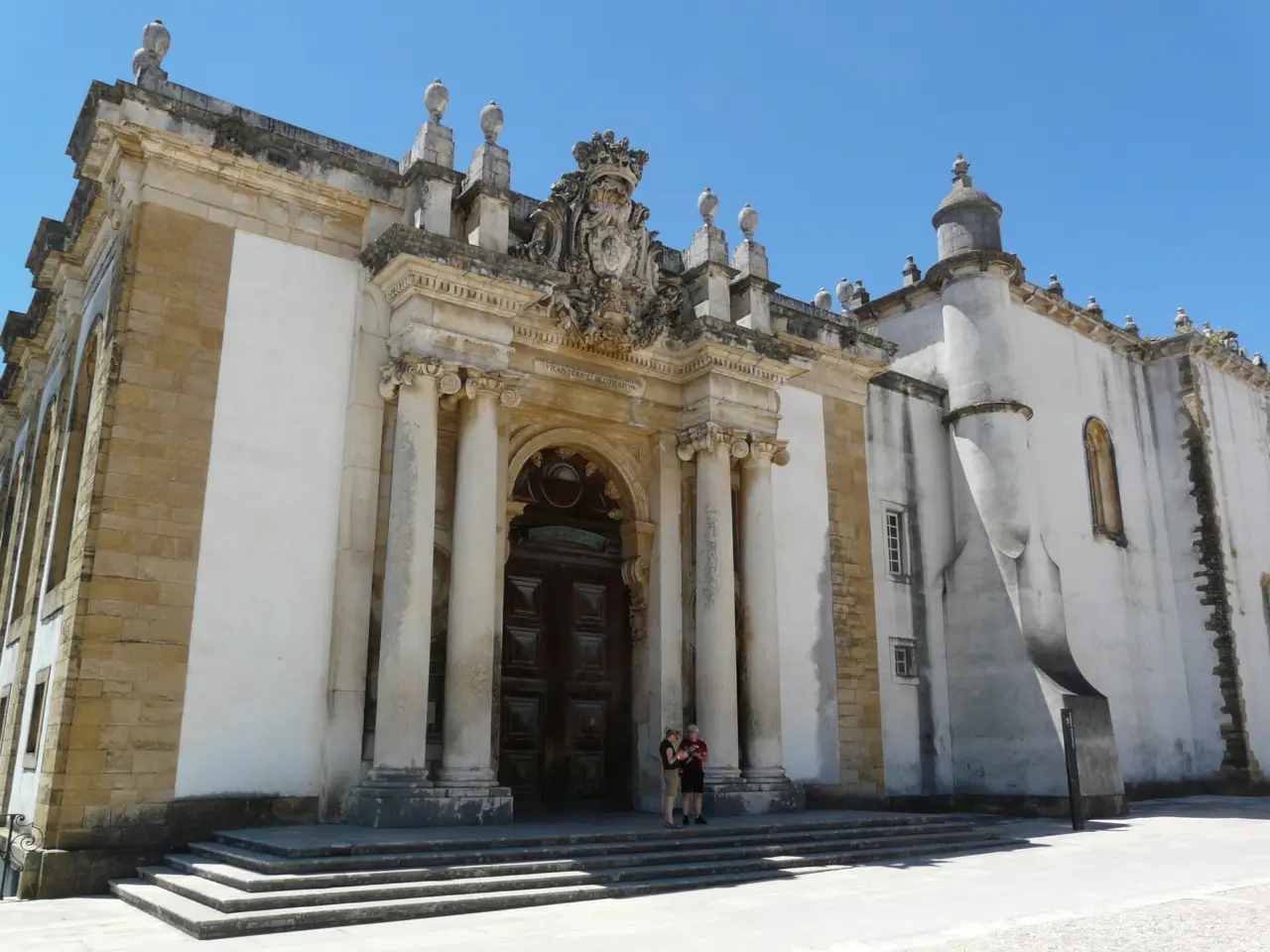
Portugal has both a sleep-designed city hotel and a sleep retreat a short drive apart. Coimbra, home to the Hästens Sleep Spa, is about an hour from Porto by fast train and under two hours from Lisbon. The Six Senses in the Douro Valley is in wine country upriver from Porto. Portugal is one hour behind Central Europe, which suits a sleep trip well: the clock change is small, and flying west makes it easier to fall asleep early. Spring and autumn are the best seasons, when days are close to 12 hours and inland nights are cool. Look for cheap flights to Porto or Lisbon.
Switzerland and Germany: the medical heavyweights
If you want doctors rather than candles, this is where to look: Chenot Palace Weggis on Lake Lucerne, the Grand Resort Bad Ragaz near the Liechtenstein border, Lanserhof Sylt on the North Sea and Lanserhof Tegernsee in Bavaria. They are expensive, but they are within a short flight or train ride of most of Europe and in the same time zone as Berlin or Stockholm.
Spain and Italy: sun, sea and sleep programmes
SHA on the Costa Blanca and Six Senses in Rome and Ibiza pair sleep programmes with Mediterranean light, outdoor exercise and late dinners. Keep the dinners early if you can. Ibiza has cheap direct flights in season, for example from Riga and Vilnius.
Finnish Lapland: dark skies and glass igloos

Lapland’s glass igloos have become a symbol of sleep tourism. You can stay in one at places like Kakslauttanen Arctic Resort near Saariselkä, about half an hour from Ivalo airport. The silence, clean air and darkness are real. Saariselkä has no sunrise at all in mid-December. But be honest about what a glass igloo is: an experience. Guests regularly mention overheating, thin curtains and little privacy, and the point is to stay awake for the aurora. For a sleep trip, book a log cabin or a hotel room with blackout blinds for most nights and one igloo night for the lights. The aurora season runs roughly from September to March. Flights to Rovaniemi or Ivalo run from Helsinki, Berlin and London.
Japan: onsen, forests and futons
Japan’s hot-spring culture is ideal for sleep. A 2019 meta-analysis in Sleep Medicine Reviews found that a warm bath or shower at 40–42.5°C one to two hours before bed helped people fall asleep faster, because it speeds up the drop in core body temperature that comes with sleep. Hoshinoya Karuizawa and Six Senses Kyoto both sell dedicated sleep stays. The catch is the time difference. Japan is eight hours ahead of Central Europe in winter, so a five-night sleep retreat there can end before your body clock has adjusted. Go for ten nights or more, or treat the first days as acclimatisation. See flights from the Baltics to Tokyo.
Thailand, the Seychelles and Hawaii: long-haul retreats
Kamalaya on Koh Samui, Six Senses Zil Pasyon in the Seychelles and the Grand Wailea on Maui all have serious sleep programmes in beautiful settings. The Seychelles is only three hours ahead of Central Europe in winter, so it is the easiest of these long-haul options for your body clock. It is also often on sale: see cheap flights to the Seychelles. Thailand is six hours ahead and Hawaii eleven hours behind, so plan long stays there.
The UK and the USA: city sleep hotels
Some of the most interesting sleep rooms are in big cities: Zedwell in London, Longueville Manor’s sleep stays on Jersey, and the Equinox and Park Hyatt sleep rooms in New York. They are good for travellers who want a city trip and good sleep, or a business trip without the usual hotel insomnia.
Jet lag: why the best sleep trip is often the closest one
This is the part most sleep tourism articles skip. Jet lag is a temporary sleep disorder, and flying east is much harder than flying west. A University of Maryland model of the body clock (Lu et al., Chaos, 2016) found that after crossing three time zones eastward it takes more than four days to fully adjust, and after six zones eastward more than eight days. Six zones westward takes about six days. The reason is that most people’s natural body clock runs slightly longer than 24 hours, so stretching the day is easier than shortening it.
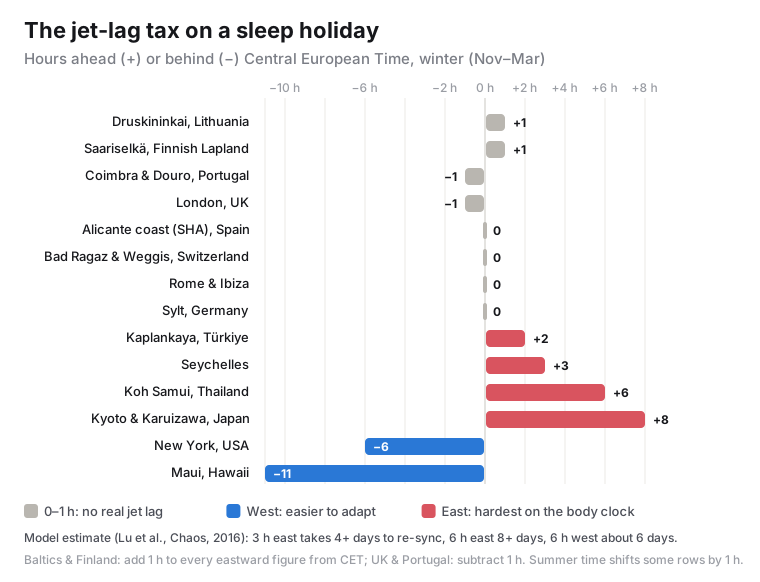
For a sleep trip of a week or less, the rule is simple: stay within two time zones. If you do go far:
- Going east (Asia): move your bedtime about an hour earlier each day for a few days before you fly. Seek morning light and avoid bright evening light after you land.
- Going west (Americas): go to bed a little later before you fly and get daylight in the late afternoon and evening after you land.
- Stay longer: a 6–8-hour time difference needs at least 10 nights so the second half of the trip is spent fully adjusted.
How much does sleep tourism cost?
The four levels cost very different amounts:
- Sleep-smart hotel night: normal hotel prices. What matters is choosing the right room and using it well.
- Sleep-designed hotel: mid-range to 4-star rates. The Hästens Sleep Spa and MANA Sleep & SPA price their rooms like other good hotels in their towns.
- Resort sleep programme: roughly €300–1,000 per person per day with the room. Six Senses Rome’s programme starts at €810 per person, and a three-night Douro Valley retreat started at £2,069 per person sharing in low season 2024.
- Medical sleep clinic: €4,000–8,000 or more per week for the programme alone, plus rooms that start around €330–600 a night.
Ways to pay less:
- Travel off-season and midweek. Spa towns such as Druskininkai, Jūrmala and Pärnu are much cheaper from Sunday to Thursday outside summer, and quieter too.
- Book a sleep-designed hotel and run your own routine. You get most of the environmental benefit without paying for a programme.
- Read the small print on “per person”. Some programme prices include the room and some do not. Six Senses Zil Pasyon and Hoshinoya Karuizawa price the programme separately, for example.
- Watch for multi-night offers. Luxury hotels often run “stay 3, pay 2” deals in quieter months, and three nights is the length you want anyway.
- Save on the flight. Short-haul sleep destinations are often cheaper to reach than the hotel costs per night. Follow our latest flight deals.
How to plan a sleep trip that actually works
- Choose 0–2 time zones for trips under a week.
- Book at least three nights, and ideally five. Night one is the “night watch”, so treat it as a warm-up.
- Pick the setting before the hotel: forest, lake, sea or countryside, away from nightlife and main roads.
- Read reviews for noise. On Booking.com and Google, search reviews for “noise”, “street”, “thin walls”, “air conditioning” and “curtains”.
- Ask for the right room when you book: a high floor, away from the lift, the street and the bar, with blackout curtains and a working thermostat.
- Set the room to 18–20°C and make it dark. Cover standby lights with tape if you need to.
- Pack a small sleep kit: an eye mask, foam earplugs and your usual pillowcase if you are a light sleeper.
- Get outside within an hour of waking up for 20–30 minutes of daylight, and keep evenings dim.
- Keep caffeine to the morning and go easy on alcohol. Alcohol may help you fall asleep but fragments the second half of the night.
- Go to bed and wake up at the same times every day, including the last day.
- Do not chase scores. If a sleep tracker makes you anxious, take it off.
- Bring two or three habits home, such as morning light, a cooler bedroom or a fixed wake-up time. That is how the benefit outlasts the first week back.
Red flags: when sleep tourism is not the answer
Sleep tourism is a lifestyle product, not medical treatment. Be careful in three situations.
If you have had insomnia for months. Chronic insomnia affects roughly 10–15% of adults. The first-line treatment recommended by both the American College of Physicians and the European Sleep Research Society is CBT-I, cognitive behavioural therapy for insomnia, which is a short course that can also be done online. A retreat can be a good place to start it, but check whether the programme actually includes CBT-I with a qualified therapist.
If you snore loudly, stop breathing at night or feel sleepy during the day. These can be signs of obstructive sleep apnoea, which affects an estimated one billion people worldwide, most of them undiagnosed. It needs a proper sleep study, which some clinics such as Bad Ragaz offer, and then medical treatment. A pillow menu will not fix it.
If the tracker becomes the problem. Sleep researchers have a name for an unhealthy obsession with perfect sleep data: orthosomnia. The Global Wellness Institute’s 2026 report warns about the rise of “sleepmaxxing” with gadgets, supplements and mouth tape. Be wary of retreats that sell you more devices than habits, and of any programme that promises to “cure” sleep in a weekend.
FAQ: sleep tourism
What is sleep tourism?
Sleep tourism is travel where the main goal is to sleep better. Travellers choose quiet, dark, sleep-designed hotels or book sleep programmes with tracking, treatments, coaching and sometimes medical diagnostics. It ranges from a carefully chosen hotel room to a week in a medical sleep clinic.
Does sleep tourism actually work?
It can, within limits. Research shows that natural daylight can shift your body clock in a few days, and that a dark, cool, quiet room helps you sleep. But the first night in any new place is lighter, and holiday benefits fade within about a week of returning to work unless you change habits at home. Choose stays of three nights or more that teach you a routine.
How much does a sleep retreat cost?
A sleep-designed hotel costs about the same as other good hotels. Resort sleep programmes cost roughly €300–1,000 per person per day, for example Six Senses Rome from €810 per person. Medical sleep clinics charge several thousand euros per week before the room: SHA from €4,000 for seven days, Lanserhof Sylt $6,040 and Chenot Palace Weggis CHF 7,960.
How many nights should a sleep holiday be?
At least three nights, and five to seven if you can. Brain studies show you sleep lighter on the first night in an unfamiliar place, and it takes a few days of consistent daylight and bedtimes to shift your body clock. If you cross six or more time zones, plan ten nights or more.
What makes a hotel good for sleep?
Control over darkness, noise and temperature matters most: blackout curtains, good soundproofing, a thermostat you can set to 18–20°C and fresh air. After that comes a comfortable mattress, a pillow choice and a quiet location away from roads and nightlife. Sleep tech such as smart beds is a bonus, not a requirement.
Where are the best sleep tourism destinations in Europe?
For value and short flights: Druskininkai in Lithuania, Coimbra and the Douro Valley in Portugal, and the Baltic spa towns of Jūrmala and Pärnu out of season. For medical programmes: Switzerland (Chenot Palace Weggis, Grand Resort Bad Ragaz), Germany (Lanserhof Sylt and Tegernsee) and Spain (SHA Wellness Clinic). For luxury programmes: Six Senses in Rome, Ibiza and the Douro Valley.
Can a sleep retreat cure insomnia or sleep apnoea?
No, not on its own. Chronic insomnia is best treated with CBT-I, cognitive behavioural therapy for insomnia, and sleep apnoea needs a sleep study and medical treatment. A medical clinic with a sleep lab can diagnose apnoea, and some retreats include elements of CBT-I, but talk to your doctor first.
Why do I sleep badly on the first night in a hotel?
It is called the first-night effect. A 2016 Brown University study found that on the first night in a new place, part of the left side of the brain sleeps less deeply and stays more alert to unusual sounds, like a night watch. On the second night both sides sleep normally. Earplugs and a familiar pillowcase can help, but the main fix is staying longer.
What is the best room temperature for sleep?
Around 18°C (65°F) is the usual recommendation, and most doctors suggest somewhere between 18 and 20°C. Many hotel rooms are warmer by default, so set the thermostat when you arrive and ask for a fan or lighter duvet if you need it.
Is sleep tourism possible on a budget?
Yes. Pick a destination within one or two time zones, fly with a low-cost airline, choose a quiet spa or countryside hotel midweek out of season and follow a simple routine of morning daylight, fixed bedtimes, a cool dark room and no late screens. Baltic spa towns such as Druskininkai, Birštonas, Jūrmala and Pärnu are some of the cheapest places in Europe to do it.
Sources
- ResMed: Fifth annual Global Sleep Survey (February 2025)
- Hilton 2024 Trends Report: sleep findings and Hilton 2026 Trends Report (October 2025)
- Global Wellness Institute: Sleep Initiative Trends for 2026 (March 2026)
- Market.us: Sleep Tourism Market (February 2025); Maximize Market Research (October 2026); Market Glass via GII (May 2025)
- Tamaki et al., Night watch in one brain hemisphere during sleep associated with the first-night effect, Current Biology (2016)
- Gooley et al., Exposure to room light before bedtime suppresses melatonin onset and shortens melatonin duration in humans, JCEM (2011)
- University of Colorado Boulder: camping and the body clock (Wright et al., 2013 and 2017)
- de Bloom et al., Effects of vacation from work on health and well-being: lots of fun, quickly gone (2010)
- AIP Publishing: Mathematical models explain east-west asymmetry of jet lag recovery (Lu et al., Chaos, 2016)
- Sleep Foundation: The best temperature for sleep
- Chenot Palace Weggis: Sleep Cycles programme
- AARP: sleep tourism destinations (May 2025)
- Premium Japan: Hoshinoya Karuizawa “Karuizawa Sleeping Stay – Summer” (June 2026)
- Druskininkai tourism office: the history of the spa
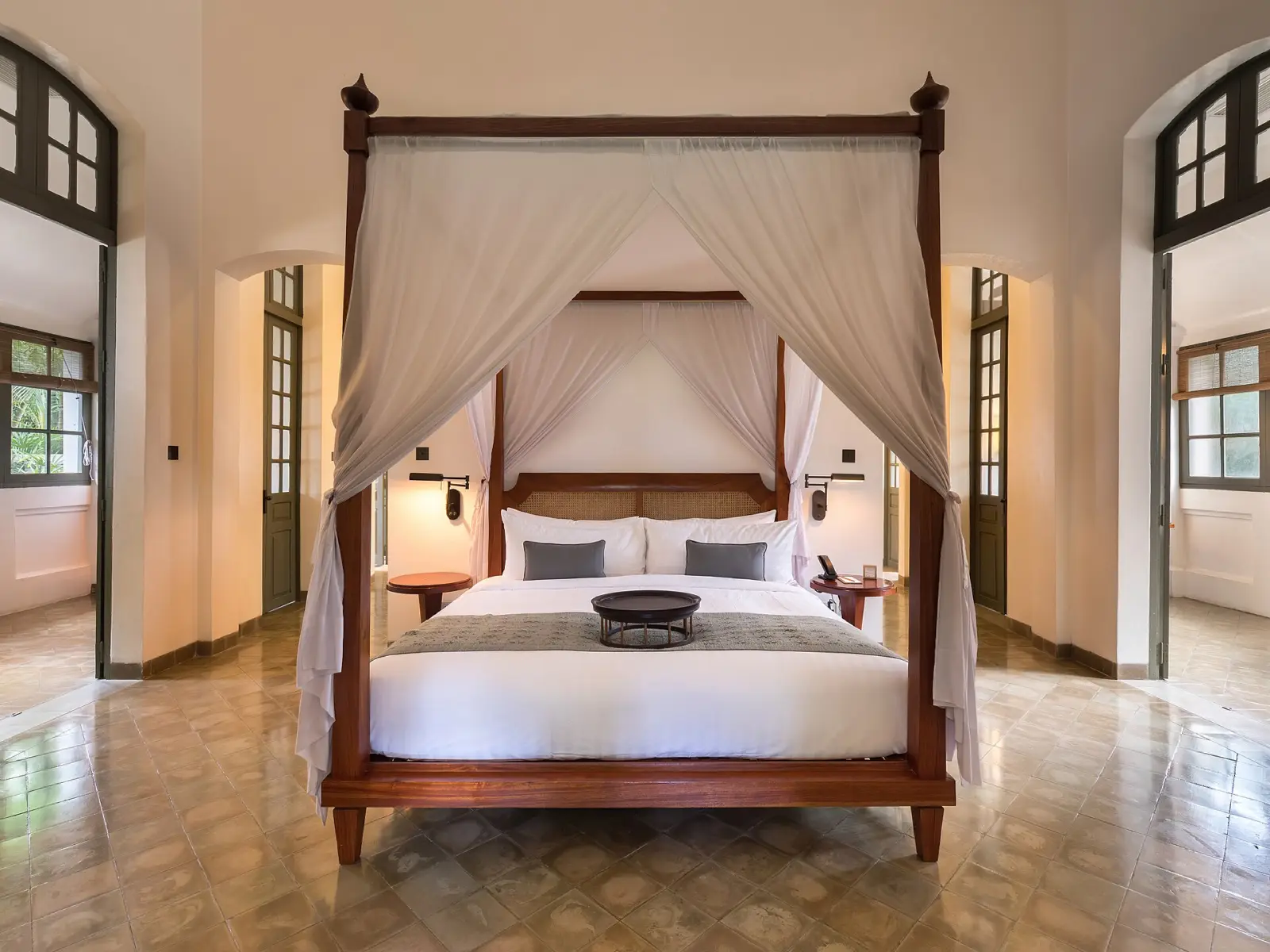
Research and prices checked on 14 October 2026. Sleep tourism programmes and prices change often, so always confirm what is included before you book. This article is general information, not medical advice. Featured photo: canopy bed at Amantaka, Luang Prabang, by Basile Morin / Wikimedia Commons, CC BY-SA 4.0.