The EU has rewritten its air passenger rights for the first time since 2004. The new law is Regulation (EU) 2026/2202, published in the Official Journal on 2 October 2026, and its rules apply to flights from 23 October 2027. The headline is reassuring: you still get €250, €400 or €600 when you reach your destination more than three hours late. What changes is almost everything around it — free personal items, automatic refunds, the right to rebook yourself, free seats next to your children, a ban on “no-show” return cancellations, and a new nine-month deadline to claim compensation.
We read the full 2026/2202 text article by article and compared it with the 2004 regulation it amends. Below is every change that matters to travellers, what stays the same, and what the new rules still don’t fix.
Key facts at a glance
- The law: Regulation (EU) 2026/2202, amending Regulation (EC) No 261/2004 and Regulation (EC) No 2027/97. Signed 16 September 2026, published 2 October 2026, in force 22 October 2026.
- Applies from: 23 October 2027. Until then, today’s rules apply.
- Compensation: unchanged at €250 / €400 / €600, still from a 3-hour delay at arrival. A plan to raise this to 4–6 hours was rejected.
- New deadline: you must claim compensation within 9 months of the flight. The airline must pay or explain why not within 30 days.
- Refunds: automatic, by bank transfer, within 7 days of choosing a refund, including booking-agency fees.
- Rebooking: if the airline offers no new routing within 3 hours, you may book your own and claim back up to 400% of your ticket price.
- Bags: a personal item up to 40 × 30 × 15 cm is always free. A cabin trolley is not guaranteed free, but fares that include one must be shown by default.
- Families: an adult travelling with a child under 14 gets a free seat next to them.
- Also new: one free name correction, no fees for a self-printed boarding pass, no forced app or account, no cancelling your return because you missed the outbound, disembarkation after 2 hours stuck on the tarmac, and free drinking water and phone charging at every EU airport.
A correction to our earlier coverage: in June 2025 we reported that EU ministers had agreed to raise the delay threshold to four hours. That was the Council’s proposal. The European Parliament rejected it, and the final law keeps three hours.
How the EU got here: 13 years in the making
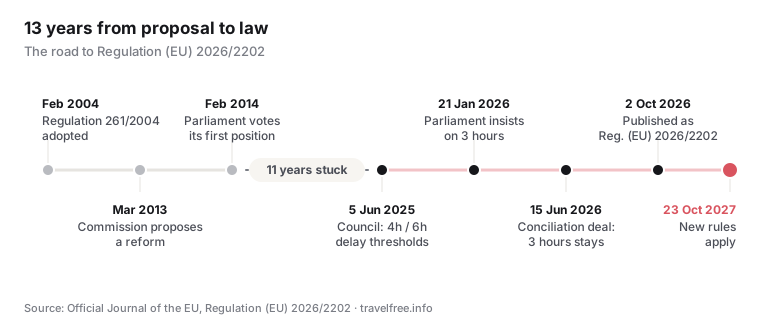
The European Commission proposed a reform in March 2013, and Parliament adopted its position in February 2014. Then the file sat in the Council for eleven years. When transport ministers finally agreed a position on 5 June 2025, it came with a price for passengers: compensation only after 4 hours (€300) on flights up to 3,500 km and after 6 hours (€500) on longer ones.
Parliament refused. On 21 January 2026 it voted for its second-reading position, which insisted on the three-hour threshold. That sent the file to a Conciliation Committee, the EU’s last-chance negotiation, which approved a joint text on 15 June 2026. Parliament endorsed it on 7 July and the Council on 13 July. The regulation was signed in Strasbourg on 16 September 2026 and published on 2 October 2026.
Before and after: every change in one table
“Today” means Regulation 261/2004 as interpreted by the EU Court of Justice. “From 23 Oct 2027” means the amended regulation.
| Topic | Today | From 23 Oct 2027 |
|---|---|---|
| Money | ||
| Compensation threshold | 3 hours late at arrival (from case law) | 3 hours, now written into the law |
| Amounts | €250 / €400 / €600 | Unchanged |
| Deadline to claim | National limitation period (e.g. 3 years in Germany, 5 in France) | 9 months from departure |
| Airline’s reply to a claim | No fixed deadline | Acknowledge immediately; pay or justify within 30 days |
| Telling you about compensation | Written notice at the airport | Electronic notice with claim instructions within 96 hours |
| Refunds | Within 7 days | Automatic within 7 days of your choice, by bank transfer, including agency fees |
| Booking your own replacement flight | Not spelled out | Allowed after 3 hours without an offer; up to 400% of the fare repaid within 14 days |
| Vouchers | Only with your signed agreement | Only with explicit consent; valid 12 months (one extension); unused balance refunded automatically |
| At the airport | ||
| Food and drink | From 2, 3 or 4 hours, depending on distance | Refreshments every 2 hours; a meal after 3 hours, then every 5 hours (max 3 a day); internet and 2 calls |
| Hotel | For as long as needed | Up to 3 nights if the cause is extraordinary (no cap for vulnerable passengers) |
| Stuck on board | Not regulated | After 30 min: water, toilets, heating or cooling. After 2 hours: back to the gate |
| Water and charging | Up to each airport | Free at every EU airport, at any time of day |
| Booking and boarding | ||
| Personal item | Airline’s own policy | Free, 40 × 30 × 15 cm or fits under the seat |
| Cabin trolley | Often a paid extra | Can still cost extra, but the fare including it is shown by default |
| Sitting with children | Often a paid seat | Free adjacent seat for under-14s’ companions |
| Name spelling mistakes | Fees common | Free at least once, if requested 48 hours before departure |
| Boarding pass | Airline’s own policy | No fee for a self-printed pass; no app or account required |
| Missed outbound flight | Return often cancelled | Return cannot be cancelled or charged for |
Compensation: what changes and what stays the same
Article 7 keeps the three bands from 2004. Distance is measured as a straight line (“great circle”) from your first departure airport to your final destination, so a connection doesn’t change the amount.
- €250 for journeys up to 1,500 km. Example: Riga–Berlin, 841 km.
- €400 for every journey within the EU over 1,500 km, and for other journeys of 1,500–3,500 km. Examples: Vilnius–Barcelona (2,258 km), Riga–London (1,662 km), and Tallinn–Tenerife: 4,685 km, but still €400, because the Canary Islands are in the EU.
- €600 for everything else. Examples: Riga–Dubai (4,320 km), or Riga–New York via Frankfurt (6,746 km, measured Riga to New York).
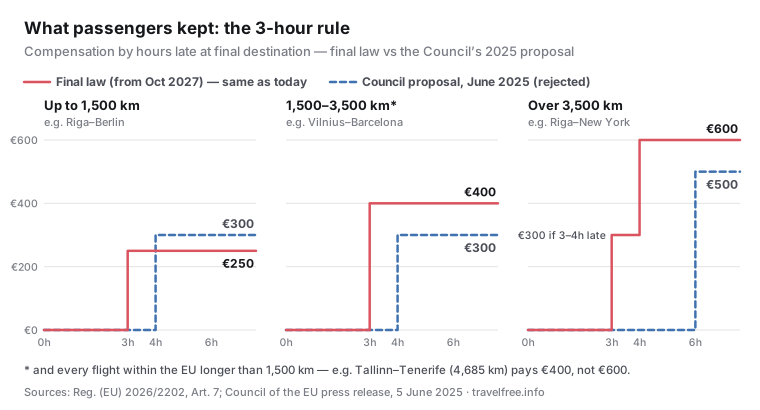
The long-haul halving rule is now written down. On €600 journeys, the airline may cut the payment to €300 if you arrive more than three but not more than four hours late. Courts already applied this reading to delays. The new Article 7(2) states it plainly.
Cancellations follow one 14-day rule. The old three-tier system (2 weeks / 7 days) is gone. You get no compensation if you were told about the cancellation at least 14 days before departure. Inside 14 days, you are owed compensation unless the airline rebooked you to leave no more than one hour earlier and arrive less than two hours later. A departure brought forward by more than one hour now counts as a cancellation in its own right.
Schedule changes have their own baseline. If the airline moves your flight at least 14 days before departure, your delay is measured from the new timetable. If it moves the flight later inside 14 days, your delay is still measured from the original booking. The clock also changes: “arrival” now means the aircraft reaching its stand with the parking brake set, not the doors opening.
You still claim “upon request”. Payment is not automatic. But within 96 hours of your journey ending, the airline must email (or otherwise send electronically) a notice of your right to compensation with instructions on how to claim. Compensation is paid by bank transfer unless you explicitly agree to something else.
What counts as an “extraordinary circumstance”
Airlines don’t pay compensation when the disruption was caused by extraordinary circumstances they couldn’t avoid. The definition has been one of the most fought-over areas in court. The new regulation writes the Court of Justice’s two-part test into law: the event must not be part of the airline’s normal activity and must be beyond its actual control. It also adds a non-exhaustive list in an annex.
On the list (the airline usually won’t pay):
- weather, natural disasters, war or serious health threats that make the flight unsafe;
- unruly passengers (unless the airline caused the behaviour) and passenger medical emergencies;
- sabotage, terrorism and security risks;
- air traffic control restrictions, airspace closures and runway closures by authorities;
- unplanned airport closures, power cuts and IT system failures at the airport;
- strikes at airports, air traffic control or ground-handling companies the airline doesn’t choose;
- bird strikes and damage caused by third parties or foreign objects;
- hidden manufacturing defects revealed by the manufacturer or an authority.
Not on the list (the airline usually pays): routine technical faults, staff shortages, and strikes by the airline’s own staff. A strike by the airline’s own staff only counts if the demands are ones that “only public authorities can satisfy”. That matches existing case law.
Two procedural changes help passengers. An event being on the list isn’t enough: the airline must prove it directly caused your disruption and that it took all reasonable measures to avoid it. And when it refuses to pay, it must name the exact annex item it relies on and explain, in plain language, how it applies to your flight.
The 9-month deadline: the change that could cost you money
This is the change most travellers will miss. Today, how long you have to claim depends on national law: three years in Germany, five in France, and other periods elsewhere. Claim companies have built a business on chasing flights from years ago.
From 23 October 2027, Article 7(9) gives you nine months from the date of departure to submit a compensation claim. The airline must acknowledge it immediately, in a durable form such as an email, and within 30 calendar days either pay or send a reasoned refusal. If you use a claims agency, the airline may ask to see proof that the agency has a valid mandate to act for you.
If the airline refuses or ignores you, you can file a complaint under the new Article 15a. That deadline is 12 months from the flight, or three months after your compensation request, whichever is later. After that come your national enforcement body, an alternative dispute resolution body, or court.
Our advice: claim within days, not months. For anything that happened before 2027, read our guides to delayed-flight compensation and cancelled-flight compensation. The new regulation doesn’t spell out how it treats older flights, so don’t sit on a claim until after October 2027.
Refunds, rebooking and vouchers
When your flight is cancelled, you’re denied boarding, your departure is 5 hours late, or you miss a connection and can’t be rebooked within 5 hours, the airline must offer you a choice. It is your choice, not the airline’s:
- A refund. It is paid automatically within 7 calendar days of your choice, by bank transfer, with no separate request needed. It covers the full ticket price plus intermediary fees, so booking-agency charges are included. If you’re mid-journey and the trip no longer makes sense, it also includes a flight back to where you started. When an airport activates its contingency plan during mass disruption, the deadline can stretch to 30 days.
- Rerouting at the earliest opportunity, under comparable conditions. The airline must now consider the same route, a different route, an alternative airport (paying the transfer), another airline, or another mode of transport such as a train.
- Rerouting at a later date that suits you, subject to seat availability.
The options must be shown neutrally. The regulation bans pre-ticked boxes and design tricks that push you towards one option, a common way of steering passengers into vouchers today.
The 3-hour, 400% self-rebooking rule
This is one of the most valuable new rights. If you’ve told the airline you want to continue your journey and it hasn’t offered a comparable rerouting within three hours, you may arrange your own. After a cancellation, the three hours run from your scheduled departure time. The airline must then repay what you spent, up to 400% of your ticket price plus agency fees, within 14 calendar days of your request.
Two conditions apply. You must tell the airline that you’re rebooking yourself, so do it in writing, in the app or by email, and keep the timestamp. And your costs must be “necessary, reasonable and appropriate”: a comparable seat, not an upgrade to business class.
Vouchers are strictly opt-in
An airline may offer a voucher instead of a refund or compensation, but only if it’s worth at least the amount owed and you give explicit consent on a durable medium. A voucher is valid for 12 months. It can be extended once by another 12 months if both sides agree. You can use it for any of the airline’s services, including flights that take place after it expires. Any unused balance is refunded automatically within seven days of expiry.
Hour by hour: what you get during a delay
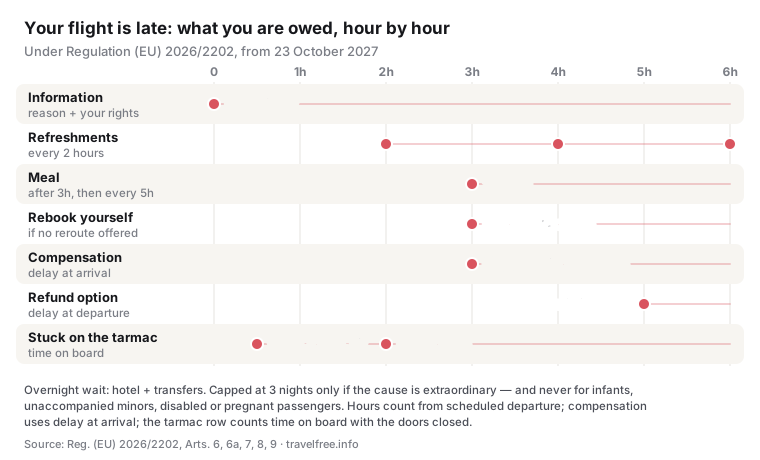
Information comes first. The airline must tell you about a delay as soon as possible, and at the latest by the scheduled departure time. Where possible it must send real-time updates, explain the reason for the delay, and set out your rights.
Care no longer depends on distance. Today, the right to food starts at 2, 3 or 4 hours depending on how far you’re flying. From 2027, everyone gets refreshments every two hours, a meal after three hours and then every five hours (up to three meals a day), plus internet access and two phone calls. Airlines may hand out vouchers instead, but meal vouchers must be accepted by every food outlet at the airport. A hotel voucher is only allowed if the airline has actually pre-booked a room.
If the airline doesn’t look after you, buy it yourself. The airline must repay reasonable costs within 14 days of your request. The law says local prices count, including airport food prices and the cost of last-minute hotel bookings in peak periods. Keep every receipt.
Hotels are capped at three nights, but only in some cases. This is one of the airlines’ wins. If the disruption is caused by extraordinary circumstances, such as a volcanic ash cloud, the airline may limit hotel accommodation to three nights. The cap never applies to people with disabilities or reduced mobility, pregnant women, infants, unaccompanied minors, or passengers needing medical assistance, or to anyone travelling with them.
Tarmac delays finally have rules. A tarmac delay is more than 30 minutes on the ground with the doors closed, before take-off or after landing. From that point the airline must keep the cabin at a comfortable temperature, keep toilets available and provide free drinking water. After two hours at an EU airport, the aircraft must return to the gate and let passengers off, unless safety, security, immigration or air traffic control reasons prevent it.
Airports get duties too. Every EU airport with commercial passenger traffic must make drinking water and device charging available free of charge, at any hour and in every terminal. Airports with more than four million passengers a year for three years running must keep a contingency plan for mass disruption, agreed with airlines and handling companies.
Cabin bags: what’s really free from 2027
This is where most headlines get it wrong, including, in part, our own earlier explainer. The final text of Article 11a says three things:
- A personal item is always free. It’s defined as a piece of unchecked baggage up to 40 × 30 × 15 cm, or any size that fits under the seat in front. The law gives examples of what a personal item is for: travel documents, medicines, phones and laptops, reading material, and food and drink for the flight.
- A cabin trolley must be permitted, subject to space, but not free. When airlines, travel agents or meta-search sites show prices, the fare including a piece of hand baggage must be displayed by default, before any booking starts. Airlines can still sell cheaper fares to passengers who choose to travel without one.
- No penalty for gate-checking. If safety, capacity or an aircraft change means your bag can’t go in the cabin, the airline may put it in the hold, but at no extra cost.
In practice, most large low-cost airlines already allow an under-seat bag at least as big as the EU minimum, so the personal-item rule protects you from future shrinkage more than it changes today’s experience. The bigger change is price comparison. Flight search results will have to lead with the “with cabin bag” price, which makes it harder for a €19 fare to win the click and become €60 at checkout. Airlines must also show exact bag sizes, weights and fees at booking and at the airport. Musicians get a dedicated right to carry instruments in the cabin.
For the airline policies in force today, see our posts on Ryanair’s cabin-bag checks and Lufthansa’s Economy Basic fare.
Families, names, boarding passes and the no-show rule
- Seats next to children: anyone accompanying a child under 14 on the same booking must be offered a seat next to the child free of charge. If no adjacent seats are left, the airline must “endeavour” to find some. The same applies to people accompanying passengers with disabilities, reduced mobility, or pregnant passengers.
- Prams and priority: children’s prams and pushchairs can be taken up to the gate or aircraft door and handed back there at no extra cost, unless safety, security, capacity or operational constraints prevent it. Families with a child in a pram get priority boarding.
- Name corrections: spelling mistakes, and administrative name changes such as after a marriage, must be corrected free at least once if you ask at least 48 hours before departure. You can’t use this to transfer a ticket to someone else.
- Boarding passes: you can’t be refused boarding, or charged, for using your own clearly printed boarding pass. Once you’ve checked in, a printed pass from the airline must be free. You can’t be forced to download an app or create an account to get a boarding pass or any information you’re legally owed.
- The no-show rule is banned: if you skip the outbound flight, the airline can no longer cancel your return on the same booking or charge you a fee for it.
Self-transfer and separate tickets: read this if you hunt cheap flights
Many of the best deals on TravelFree are built from separate tickets: one airline to a hub, another onward. The new rules make your protection on a single booking stronger. If you miss a connection because the first flight was late, the airline that ran the late flight must reroute you, look after you, and pay compensation based on your arrival time at your final destination.
With separate tickets, none of that applies to the missed second flight. The new law doesn’t change that. What it adds is honesty at the point of sale: an airline or agency selling tickets on separate contracts must tell you before you pay, clearly and in writing, that the missed-connection rights don’t apply. There’s also a new voluntary “Union Air Passenger Rights Label” that sellers can display next to journeys that are fully covered.
Rule of thumb: on separate tickets, leave a long buffer, especially before a long-haul flight, and consider insurance that covers missed connections.
Which flights are covered?
- Any flight departing from an EU airport, on any airline.
- Flights into the EU from a non-EU country, but only on an EU airline, and not if you already received equivalent compensation and assistance in that country. Example: New York–Frankfurt is covered on Lufthansa but not on a US airline.
- Award tickets booked with frequent-flyer miles are fully covered. Free or non-public fares are not. Infants travelling free and companions of disabled passengers get every right except compensation.
- Package holidays: you can claim under the air passenger rules, the Package Travel Directive, or both. Amounts that compensate the same loss are offset, so you can’t be paid twice.
- Not covered: compensation for flights entirely within Greenland, and flights on helicopters or other aircraft that aren’t motorised fixed-wing.
What the reform still doesn’t fix
An honest assessment includes the gaps:
- No protection if your airline goes bust. The regulation explicitly leaves insolvency protection for a later review of the EU’s air services rules. If your airline collapses, these rights don’t refund your ticket. It’s a live issue for Baltic travellers after airBaltic’s Chapter 11 filing.
- No automatic compensation. You still have to claim. The Commission must study “further automation” of compensation for its first review, due by 23 October 2031.
- No uniform trolley size. Only the personal item has fixed dimensions. A common hand-baggage size is deferred to a future review.
- Amounts aren’t indexed. €600 bought more in 2004 than it does now. The 2031 review must consider inflation and fares, but nothing changes automatically.
- Non-EU airlines flying into the EU stay outside the rules. The Commission is asked to assess this too.
Who won? Our take
Passengers kept the most important thing: the three-hour threshold and the full €250–€600 amounts. They also gained a long list of enforceable rights that today depend on court cases or airline goodwill: self-rebooking after three hours, automatic refunds including agency fees, deadlines for airline replies, free seats with children, free name fixes, tarmac limits and fairer vouchers.
Airlines won certainty and some limits. These include a written list of extraordinary circumstances (including air traffic control and airport strikes), a three-night hotel cap in force-majeure events, a strict nine-month claim window, mandate checks on claim agencies, and confirmation that they can recover costs from airports and other third parties.
For the average traveller, the reform is clearly positive. The one exception is the claim window: nine months is short, and the people it will hurt most are those who don’t know it exists.
What to do now
- Nothing changes for flights before 23 October 2027. Today’s rules and national claim deadlines still apply. If you have an old disrupted flight, claim it now.
- From October 2027, claim within days. Watch for the airline’s 96-hour email, and screenshot everything.
- Put your bank details on file. Refunds and compensation are paid by transfer unless you agree otherwise, so don’t accept a voucher by accident.
- In a long disruption, write down the time you asked to continue your journey. If nothing comparable is offered within three hours, you can book your own replacement and claim it back.
- Book families on one reservation. The free adjacent-seat right applies to companions “under the same air transport contract”.
FAQ: New EU air passenger rights
When do the new EU air passenger rights start?
Regulation (EU) 2026/2202 entered into force on 22 October 2026, but its rules apply from 23 October 2027. Until that date, the current Regulation 261/2004 applies unchanged, including today’s national deadlines for claiming compensation.
Is the 3-hour delay rule changing?
No. You are still entitled to compensation if you reach your final destination more than three hours late, and the rule is now written into the regulation itself. The Council proposed raising the threshold to four hours (up to 3,500 km) and six hours (longer flights), but the European Parliament rejected it.
How much compensation will I get under the new rules?
€250 for journeys up to 1,500 km, €400 for longer journeys within the EU and other journeys of 1,500–3,500 km, and €600 for longer journeys. On €600 journeys the airline may halve the payment to €300 if you arrive between three and four hours late. Distance is measured from your first departure airport to your final destination.
Will hand luggage be free from 2027?
A personal item up to 40 × 30 × 15 cm, or one that fits under the seat in front, will always be free. A larger cabin trolley is not guaranteed free. Airlines must allow one subject to cabin space and must show the fare including it by default, but they can still sell cheaper fares without it.
How long do I have to claim flight compensation?
For flights from 23 October 2027, you must submit your claim within nine months of the departure date. The airline must acknowledge it immediately and pay or give a reasoned refusal within 30 calendar days. You then have at least 12 months from the flight to file a formal complaint.
Can I book another flight myself if my flight is cancelled?
Yes, from October 2027. If you tell the airline you want to continue your journey and it offers no comparable rerouting within three hours of the scheduled departure, you can arrange your own. The airline must repay reasonable costs up to 400% of your ticket price, plus agency fees, within 14 days. Tell the airline before you book, and keep your receipts.
Can airlines charge to seat my child next to me?
No. From 23 October 2027, an adult accompanying a child under 14 on the same booking must be offered an adjacent seat free of charge. The same right covers companions of passengers with disabilities, reduced mobility, or pregnant passengers.
Are technical problems an extraordinary circumstance?
Generally no. Routine technical faults, staff shortages and strikes by the airline’s own staff are not on the regulation’s list of extraordinary circumstances. Hidden manufacturing defects revealed by the manufacturer or an authority are listed. Even then, the airline must prove the event directly caused your disruption and that it took all reasonable measures.
Will the airline cancel my return flight if I miss the outbound?
Not any more. The new rules ban airlines from denying boarding on, or charging a fee for, the return part of a booking because you didn’t take the outbound flight on the same contract.
Does the new regulation apply to non-EU airlines?
Yes, for every flight departing from an EU airport. For flights into the EU from outside, it applies only when the airline is an EU carrier, and not if you already received equivalent compensation and care in the departure country.
Sources
- Regulation (EU) 2026/2202, Official Journal of the European Union, 2 October 2026 (EUR-Lex)
- Regulation (EC) No 261/2004, the original 2004 text (EUR-Lex)
- Council of the EU: Council sets position on clearer and improved rules for air passengers (5 June 2025)
- European Parliament: Parliament stands behind air passenger rights (January 2026)
Checked against the published text of Regulation (EU) 2026/2202 on 11 October 2026. This article explains the law in general terms and is not legal advice. For a specific claim, contact the airline first, then your national enforcement body.