

In 2024, 1.1 billion air passengers travelled in the EU – 8.3% more than in 2023. Discover which countries and airports grew the fastest, how air freight changed and what these Eurostat 2024 air travel statistics mean for travellers.
Number of air passengers in the EU up 8% in 2024
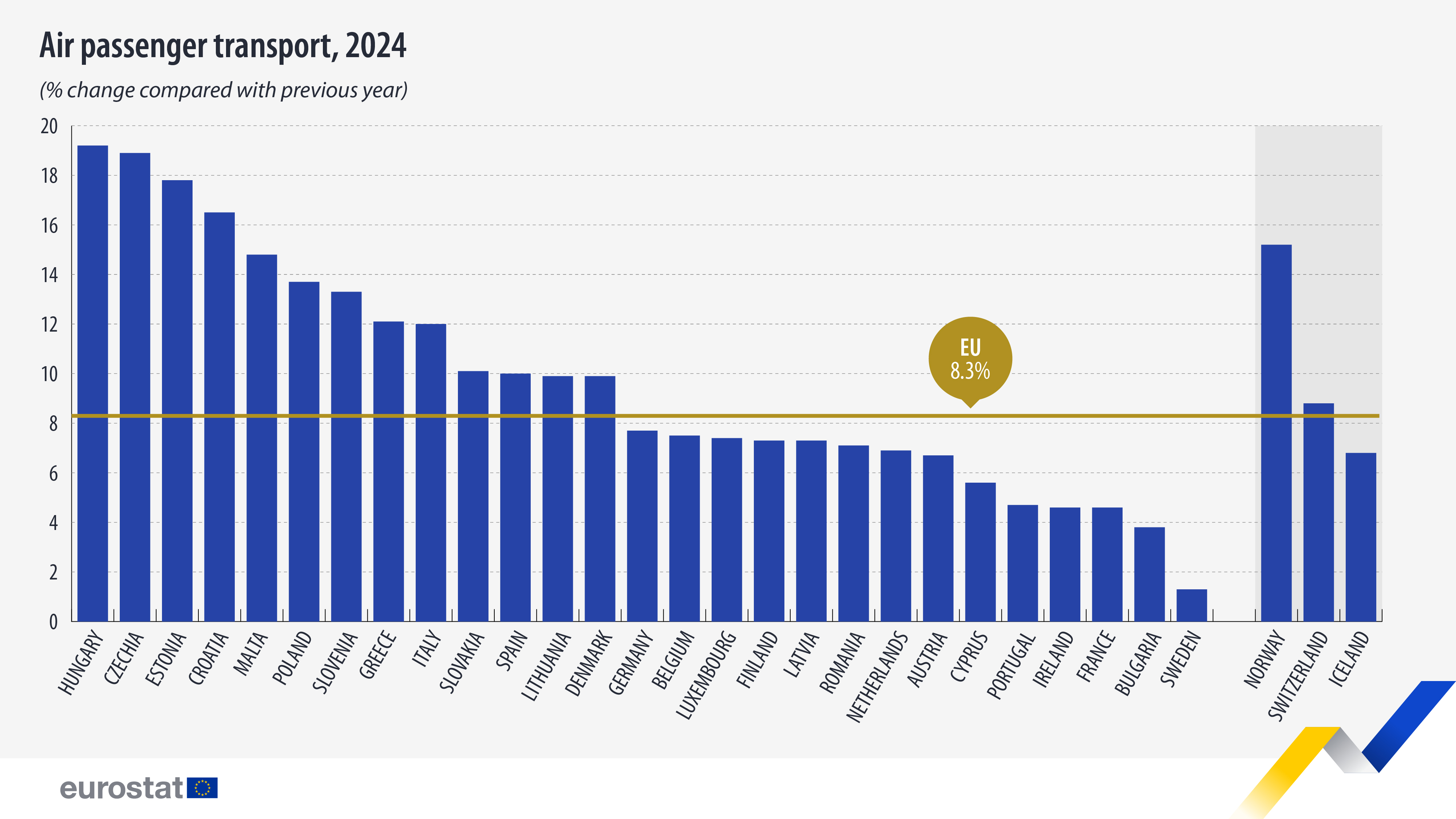
According to fresh Eurostat data, air travel in the European Union continued its recovery in 2024. In total, 1.1 billion passengers travelled by air across the EU – an 8.3% increase compared with 2023, when 973 million passengers were recorded.
This means that EU air traffic has again firmly crossed the one billion passenger mark, confirming strong demand for both leisure and business travel across Europe.
All EU countries saw more air passengers in 2024
One of the key findings from Eurostat: every single EU country recorded growth in air passengers in 2024 compared with 2023.
Fastest-growing countries for air passengers
The strongest growth in passenger numbers was registered in Central and Eastern Europe:
- Hungary: +19.2%
- Czechia: +18.9%
- Estonia: +17.8%
These double-digit increases reflect:
- Rapid expansion of low-cost carriers and new routes,
- Growing tourism to Central and Eastern Europe,
- Strong outbound travel demand from local residents.
Countries with slower, but still positive growth
At the other end of the scale, some countries saw more modest increases – but still positive:
- Sweden: +1.3%
- Bulgaria: +3.8%
- France: +4.6%
- Ireland: +4.6%
These lower growth rates may be linked to:
- Environmental debates and flight taxes (especially in Nordic countries),
- Already high passenger bases in France and Ireland,
- Strong competition from rail and other modes on shorter routes.
EU air freight and mail also increased in 2024
It wasn’t just passengers who came back in 2024 – air freight and mail transport in the EU also grew.
Compared with 2023, total air freight and mail in the EU was:
- +8.7% in 2024 overall,
- driven mainly by extra-EU traffic (+10.8%),
- while intra-EU traffic stayed almost flat (+0.1%),
- and domestic air freight actually fell (-4.3%).
Which countries led in cargo growth?
For freight and mail, the biggest national increases were:
- Hungary: +65.9%
- Czechia: +43.7%
- Greece: +36.7%
Only two EU countries recorded declines in freight and mail volumes:
- Poland: -3.6%
- Latvia: -2.7%
So even though passenger numbers rose everywhere, some markets still saw a slight cooling in air cargo, possibly due to changing supply chains and a shift back to sea freight for some goods.
The EU’s busiest airports in 2024
When looking at individual airports, Eurostat’s figures show that the top 9 EU airports by passenger numbers remained the same as in 2023.
Among the top 10 EU airports, the following handled the largest number of passengers in 2024:
- Paris Charles de Gaulle (CDG): 70.3 million passengers (+4.3%)
- Amsterdam Schiphol (AMS): 66.8 million (+8.0%)
- Madrid Barajas (MAD): 66.1 million (+9.9%)
- Frankfurt/Main (FRA): 61.5 million (+3.7%)
- Barcelona El Prat (BCN): 54.9 million (+10.3%)
A particularly strong comeback came from:
- Rome Fiumicino (FCO) – 48.7 million passengers and the fastest growth among the top 10 EU airports, with a +20.8% increase vs 2023.
- Athens Eleftherios Venizelos (ATH) – moved into the top 10 EU airports, replacing Paris Orly, after a passenger growth of +19.6% compared with 2023.
Together, these numbers confirm what many travellers already feel at the terminals: European hubs are busy again, with queues, full flights and packed departure boards.
What counts as “passengers carried”?
Eurostat uses a specific definition for its air passenger statistics:
- “Passengers carried” are counted once per flight,
- Direct transit passengers (who remain on the same aircraft and are simply in transit) are excluded.
This helps ensure that the figures reflect actual travellers starting or finishing trips in EU airports, not double-counting the same people when they connect.
What this means for travellers and the air industry
These 2024 EU air travel statistics tell an important story for both travellers and the aviation sector:
- More choice & connectivity:
Rapid growth in countries like Hungary, Czechia and Estonia suggests new routes, more low-cost options and better regional connectivity for passengers. - Busy hubs, potential bottlenecks:
With major EU airports again handling tens of millions of passengers per year, travellers should expect crowded terminals, longer queues and busier peak times, especially at top hubs such as Paris CDG, Amsterdam and Madrid. - Cargo trends still shifting:
The strong growth in extra-EU air freight, combined with flat intra-EU and falling domestic freight, shows how global trade patterns are still adjusting after the pandemic and supply chain disruptions. - Sustainability challenges:
With EU air travel volumes now back above one billion passengers a year, the pressure to decarbonise aviation will only increase – from sustainable aviation fuels to more efficient aircraft and better rail alternatives on short-haul routes.
Summary
- 1.1 billion passengers flew in the EU in 2024 (+8.3% vs 2023).
- All EU countries saw growth in air passengers.
- Fastest-growing passenger markets: Hungary, Czechia, Estonia.
- Air freight and mail were up 8.7%, driven by extra-EU traffic, while domestic freight declined.
- Top EU hubs like Paris CDG, Amsterdam and Madrid strengthened their positions, while Rome Fiumicino and Athens recorded particularly strong growth and Athens entered the EU top-10 airports list.